For the European Streetteam challenge I wanted to make some bats so I needed black clay & decided to make it myself.
Here is what you need:
Black body stain, a mask, a scale, gloves, white/grey clay, paper
 Weigh the amount of clay you want to color.
 Put a piece of paper on your scale and weigh the amount of body stain you want to add.
For black I use more then other colors because I want to make sure it's really black and not a greyish black. I used 4 grams to 200 grams.
 Put on your gloves and make a little bowl out of your lump of clay.
(my apologies for the bad quality of these pictures)
 Put the body stain in the little bowl.
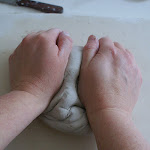
  Fold the bowl close and start kneading carefully so that not too much body stain falls out.
 When the clay starts getting too dry, add a bit of water and knead well so that the body stain really mixes with the clay.
 This is how it looks when it's ready to use.
 Clay dries out really fast, so I usually hold it in a plastic bag and I wrap the part that I'm working with in a damp cloth.
 I use a mould that I made to make the bats.
 Take a little clay and press it into the mould.
 Make sure that it's filled up nicely.
 Take a piece of moist clay and press it onto the filled mould and 'pull' the bat out.
 I think it came out nicely.
 Hey look, small and big ones! :)
  And here is how they look when they are fired.
Hey, they turned out grey instead of black! :(
I definately need to use more black body stain next time.
Well, that's what experimenting is all about! :)